Blog
Your Next Household Battery Could Have Four Wheels
Your car's battery is bigger than the one on your wall and spends most of the day parked on the drive doing nothing. The maths on using a second-hand EV, like a VW ID.5, to help power the house too.
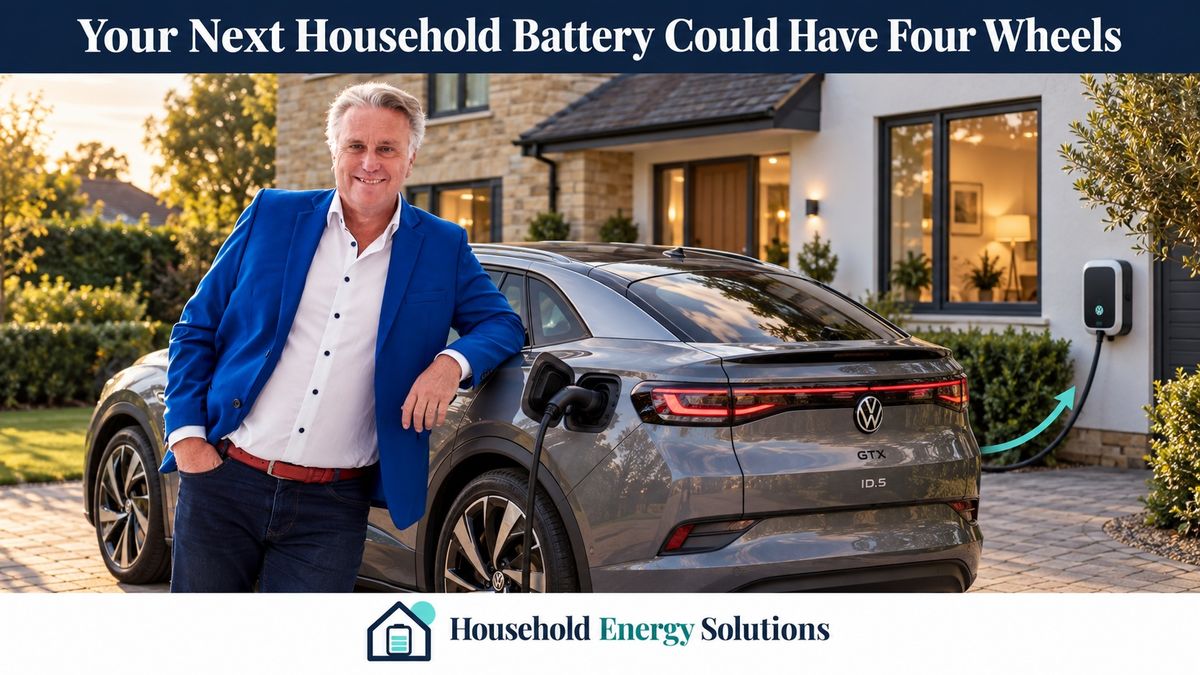
In the future, I think many households will buy a second electric car with two jobs in mind. The first will be getting the children to school, doing the weekly shop and making everyday journeys. But interestingly, the second will be slashing energy bills by storing cheap overnight energy and using it to avoid higher daytime rates.
Once the technology becomes widely available at the right price, the economics could become overwhelmingly positive for the right household, and Household Energy Solution has this opportunity clearly in our sights.
When you have already paid for a large battery as part of buying the car, why leave it sitting on the driveway doing nothing?
A dedicated household battery has one purpose: storing electricity until we need it, and these are easy to install and implement, with payback periods under 5 years. But our electric cars have a much larger battery that spends much of its life parked outside our houses. Connecting that storage to the house creates an opportunity to get more value from something we already own.
The principle is straightforward. Charge the car overnight when electricity costs 8p, drive it when needed at an ultra-low 2p per mile, and then use the remaining energy down to a minimum of 10% to power the house when electricity costs 3X as much at 28p per minute. Recharge overnight and repeat.
This is particularly interesting for someone working from home or staying at home to manage the kids and the household generally. The car might leave the driveway for the school run, shopping or appointments, but spend most of the day parked outside. In a two-car household, using the other vehicle for weekend trips could leave this one connected throughout Saturday and Sunday.
And it need not be an entry-level runaround, if you don’t want it to be.
Take a Volkswagen ID.5 GTX. This sporty family SUV has a substantial 77kWh battery. During our research, we found a three-year-old example advertised at £17,290, although a quick £150 battery health check would be needed, as it has 86,000 miles on the clock, which, despite many misconceptions, is not an issue for most EV batteries, as they run well into the 200,000-mile range.
Volkswagen has already announced vehicle-to-home capability for qualifying 77kWh ID models with the necessary software and compatible equipment. The outstanding challenge is making the complete installation readily available and affordable in the UK.
Let us assume that happens, and Household Energy Solutions are working with suppliers to get the additional cost over an ordinary home charger down to £5,000.
In our worked example, we assume the used car retains 70 kWh of usable battery capacity. We then charge it to just 80% to treat it carefully and insist on always preserving 30% for driving tasks. This leaves 35 kWh of battery capacity available, which is more than enough to power the average daily home usage of 19.5 kWh, meaning that virtually all electricity costs are reduced to the 8p cheap night rate.
That would cover all daytime electricity needs while the car is home, followed by cooking, lighting, television and other evening consumption. At weekends, with no driving, we modelled 22kWh of household supply each day.
Using illustrative electricity prices of 8p per unit overnight and 28p during the day, and allowing for charging and discharging losses, the annual electricity saving is approximately £1,240. This includes an allowance for missed weekdays.
The extra £5,000 installation would therefore repay itself in around four years. Allowing an illustrative £200 annually for additional running costs and depreciation extends that to approximately 4.8 years, but gives a car that can stay plugged in for at least another 5 years, delivering £6,200 in savings, and even then you just switch to another car, and you already have all the kit paid off.
The crucial point is that this calculation does not credit the massive saving the car delivers at 2p per mile, compared with the old 17p per mile car you currently have. This choice is an independent one you are already making, but it just shows how using it to power the house can boost this massive energy saving even further.
We are just assessing the payback on the additional investment needed to give it a second job. Buying a more expensive vehicle solely for this purpose would change the calculation.
A few other factors matter. Thirty miles of local errands is different from two or three hours of continuous driving. The house must also consume enough electricity to use the stored energy, since a larger battery doesn't create savings if it sits idle in a low-consumption home.
Nevertheless, the direction is exciting. We are moving towards a world where the second household car becomes part of the home’s energy system.
At Household Energy Solutions, I see this as a product to develop carefully alongside dedicated household batteries. The £5,000 installation remains a target, and we need proven, supported packages before recommending them.
But imagine choosing your next car knowing it could take the children to school, carry the weekly shopping and reduce your household electricity bill by around £100 a month.
That gives “the family car” a rather bigger job description.